Key takeaways
- Drones inspect confined spaces without putting people into hazardous, hard-to-reach areas.
- Inspections compress from days to hours, cutting facility downtime and equipment cost.
- 4K, thermal and ground-control-station imaging delivers high-quality data for 3D models and decisions.
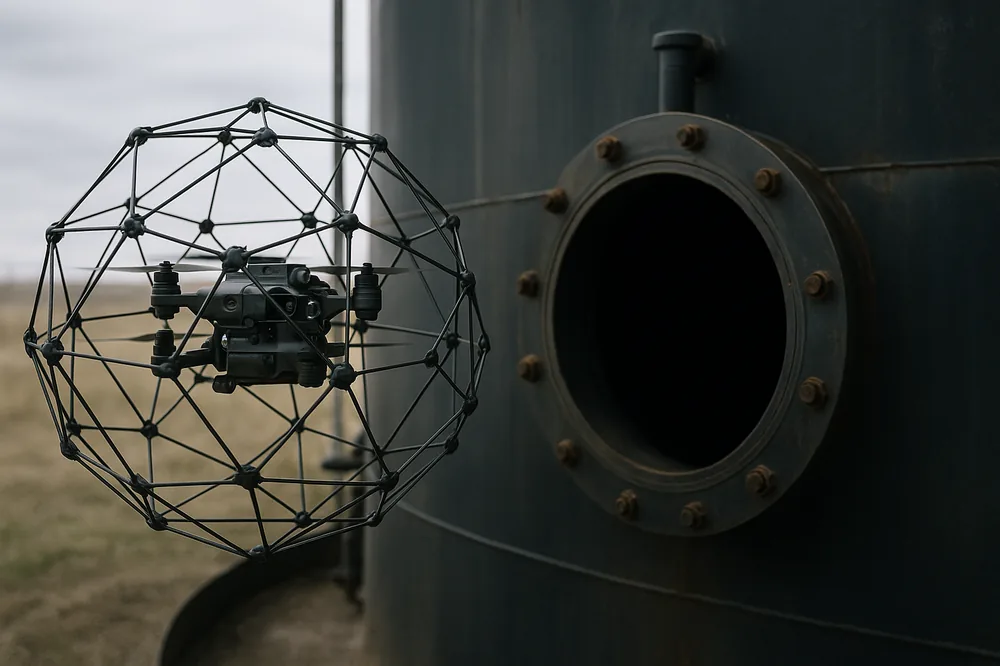
Doing any kind of work in confined spaces is difficult and dangerous. When it comes to inspecting these areas, having humans do the work manually is not efficient. Our confined space drone inspections allow your business to get the results you need with:
1. Better Access
Often spaces are unreachable, dangerous for humans, or give inaccurate results. UAVs are an asset to your organization because they can inspect and explore indoor and confined spaces with ease. They are equipped to bring you access to important spaces utilizing technology.
2. Improved Safety
Typically, confined space inspections can be dangerous for your team. These confined spaces can be difficult to reach or completely unreachable by humans. By utilizing drone technology, human risk can be minimized by decreasing their involvement within the process. Certified UAV pilots have the knowledge and expertise to complete your project for easy and safe confined space drone inspections.
3. Reduced Downtime
Confined space inspections can require downtime of your facility and your team. Drones can be quickly deployed in the most difficult areas to reach. This means your inspection downtime will be reduced and projects completed in hours rather than days.
4. Lowered Costs
With inspections, you may require access to scaffolding, cranes or other expensive equipment. UAVs can reach differing heights, depths, and tight spaces at a reduced cost. It is an inexpensive way to get the world-class results you need without breaking the bank.
5. Superior Imaging
UAVs have the best, most current technology. Equipped with 4K cameras and lighting, drones can inspect even the darkest of environments in great detail. They also offer 360 horizontal views and 215-degree vertical views meaning no matter what the dimensions of your space, it can be inspected thoroughly.
6. Thermal Imaging
Thermal Imaging is a standard tool for visualizing the unseen. It allows inspection operators to see heat signatures of your inspection asset in order to detect potential problems. When you gain a better perspective on all potential problems or issues, you and your team can make more informed decisions. This unparalleled advantage can help you be more efficient in your maintenance procedures.
7. Ground Control Stations
Ground control stations allow live streaming video and telemetry data communication between inspection personnel and the drone. All pertinent information is constantly updating. With these updates, experienced pilots can change camera exposure, light intensity, and angles. You get a better look at your site in real-time which allows you to examine issues thoroughly.
8. High Quality Data
Data acquisition and processing is one of the greatest advantages of confined space drone inspections. All data is recorded and stored within the UAV. This can be used as stand alone video clips, or stills, but can also be combine and processed to build photogrammetric 3D models. You’ll be able to reach new depths, new heights, while obtaining insights and methods of documentation that provide innovative opportunities for analysis and collaboration.
Start Benefiting from Confined Space Drone Inspections
UAV Imaging is pleased to offer confined space drone inspections for a variety of industries. Our knowledgeable, certified pilots understand each space is different and works with you to understand the unique needs of your inspection. We are Transport Canada compliant and complete your project quickly and safely.