

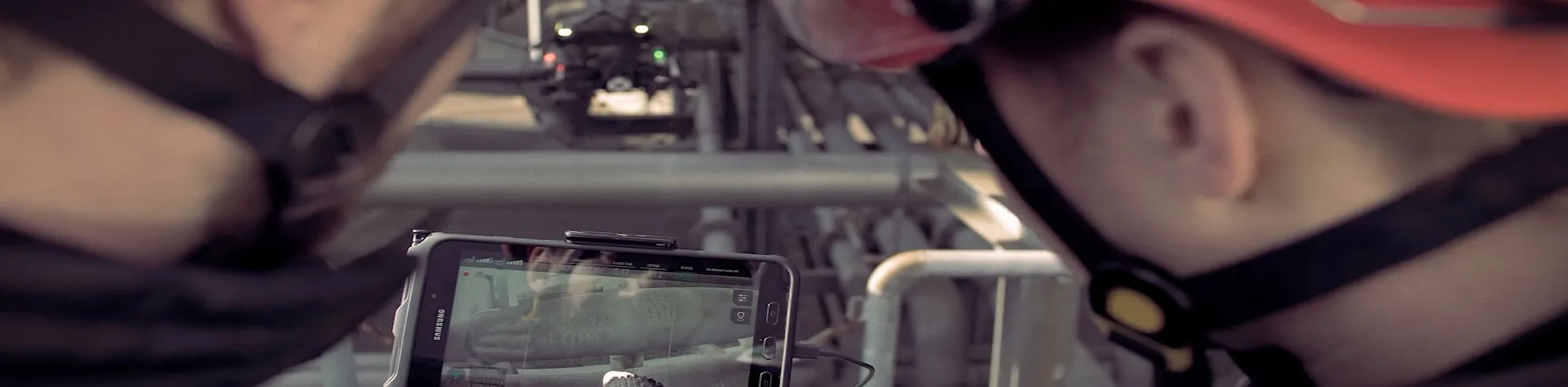
Case Study: Elios 2 Replaces Confined-Space Entry for Crude Storage Tank Inspection
Storage tank internal inspection has historically required confined-space entry — a permit, a standby rescue team, atmospheric monitoring, scaffolding or rope access, and a trained inspector inside the tank for hours. UAV Imaging documented a side-by-side comparison on a working central Alberta crude storage tank between the planned entry workflow and a Flyability Elios 2 drone flight. Identifying details are withheld at the operator's request; the methodology and result deltas are reported as measured.
Asset profile
- Tank type: Vertical fixed-roof welded steel crude storage tank
- Approximate capacity: 4,000 cubic metres (roughly 25,000 bbl)
- Diameter / height: 18 m diameter, 16 m shell height
- Inspection scope: General visual interior condition — shell, deck underside, internal piping, agitator, floor (post-cleaning)
- Pre-condition: Tank emptied, cleaned, ventilated, atmosphere verified for entry
Method 1: planned confined-space entry (baseline)
- 1 inspector + 1 standby attendant + 1 rescue technician on site
- Confined-space entry permit + rescue plan + atmospheric continuous monitoring
- Scaffolding rental + rigging for deck-underside access
- Total on-site time: 2 days (mobilization, scaffold build, inspection, scaffold tear-down, demob)
- Total all-in cost: ~$22,000 (inspector, attendant, rescue, scaffold, monitoring, paperwork)
- Tank out-of-service time: 3 days
- Deliverable: Inspector's PDF report with hand-marked sketch and photo callouts
Method 2: Elios 2 drone flight
- 2-person UAV Imaging crew (pilot + visual observer) + 1 operator-side liaison
- No confined-space entry permit (no human enters the tank)
- No scaffolding required
- Atmospheric monitoring outside the tank manway only
- On-site time: 4 hours (setup, fly, demob)
- Total all-in cost: ~$5,800 (flight, post-flight reporting, mobilization)
- Tank out-of-service time: 6 hours (manway open during flight only)
- Deliverable: 4K video walkdown, 200+ HD stills, thermal record, marked-up defect map, written report with severity ranking
Results — same tank, two methods
| Metric | Confined-space entry | Elios 2 drone | Delta |
|---|---|---|---|
| All-in cost | ~$22,000 | ~$5,800 | -74% |
| On-site time | 2 days | 4 hours | -75% |
| Tank out-of-service | 3 days | 6 hours | -92% |
| Confined-space entries | 1 | 0 | -100% |
| Defects identified | 17 | 19 | +2 (drone caught 2 more via thermal) |
| Deliverable richness | PDF + sketch + photos | 4K video + stills + thermal + defect map | — |
What the numbers mean in practice
- Safety is the headline. Eliminating the confined-space entry removes the highest-risk task in tank inspection. No human inside the tank, no standby rescue exposure.
- Schedule compresses dramatically. Six hours of out-of-service for the drone vs three days for the entry workflow means the tank is back in service the same day on a typical drone job.
- Defect coverage is at parity or better. The Elios 2 found two additional defects on this asset — one warm spot on the shell exterior visible from inside via thermal contrast, and one weld root-pass defect on a deck stiffener visible from a flight angle that scaffolding access could not reach.
- Deliverable is richer. A full 4K video walkdown plus thermal lets the operator's inspector review the inspection again later without re-entering the tank or re-deploying a crew.
Where confined-space entry still wins
The Elios 2 does not perform contact-required tasks — ultrasonic thickness, magnetic-particle inspection, coatings sampling, or tactile examination of welds. When the inspection scope includes any of those, the human entry remains required. The drone is the right tool when the scope is visual general-condition inspection or pre-entry reconnaissance.
How operators are using this
The pattern that has emerged across central Alberta operators is to run an Elios 2 flight as the first-pass inspection on every fixed-roof tank in the asset register, then schedule confined-space entries only on tanks where the drone identified a defect requiring contact-method follow-up. That sequencing typically cuts confined-space entries by 60-80% across the asset base.